On this page
You book more meetings from LinkedIn by finding the one stage where people drop out and fixing that before anything else. The stages are the invite, the reply, the ask and the show up, and on our numbers and on a large public benchmark, most people are lost at the very first one.
I do not have a meetings number to give you, so I will not make one up. I do have two real numbers from our own outreach and one public benchmark, with their sample sizes, plus a way to find your own leak in two weeks.
I run Voice Outreach, so I have a side. Voice notes come into this post once, in the middle, and I say what I do not know about them.
What does it take to get a meeting from LinkedIn?
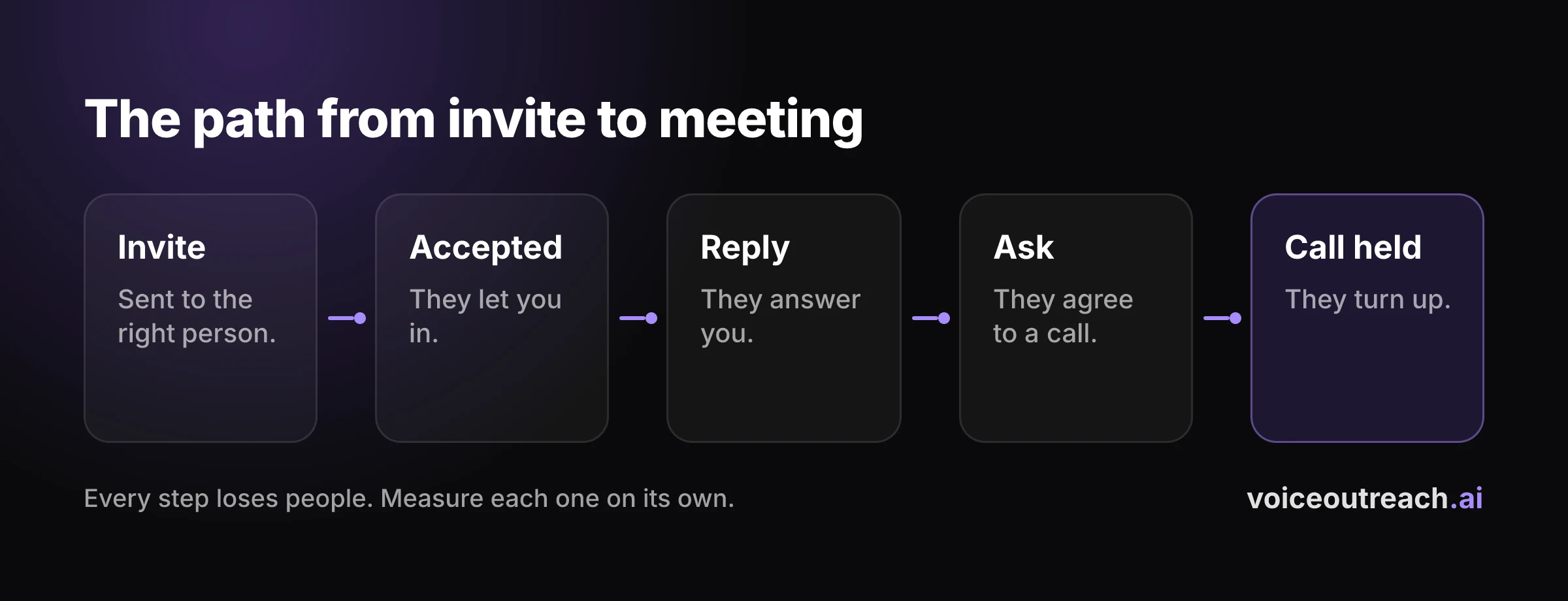
Five things have to happen in order. You invite the right person, they accept, they reply, they agree to a call, and then they turn up.
Every step loses people. That is how a funnel works, but it means one weak step caps everything after it.
Several of the guides I read lead with scheduling links, which belong to the last step. That is the least likely place to find your problem.
What is a good connection acceptance rate?
About one in four cold invites gets accepted, going by the two sources I trust. Your number will move with your list and your profile.
The biggest public dataset I found with a stated method is Expandi's. It sells a LinkedIn automation tool, so this is vendor data from its own users. Its 2026 benchmarks put acceptance at 28.5%, which is 3,766,161 accepted from 13,218,869 requests across 13,302 accounts between 1 May 2025 and 30 April 2026.
Here is ours, with the sample size.
23.8%
of our connection requests were accepted. That is 195 from 819 invites.
The two audiences have nothing in common, so do not read anything into the gap. Read the other side of the number instead. Roughly three in four people we invited never gave us the chance to say anything, and the Expandi figure leaves about seven in ten.
So if replies are low, check acceptance first. You may be talking to a quarter of your list.
What moves acceptance?
Mostly things that happen before the invite. Some of this is my opinion, and I mark it.
- The list. Invite people who have a reason to know you exist. A cold list of strangers is the usual cause of a low rate. (Opinion.)
- Your profile. People look before they accept. A photo and a headline that says who you help is most of the work. (Opinion.)
- A short note, when you can send one. LinkedIn's own advice for avoiding restrictions is to add a personalised message saying how you know someone or why you want to connect. Free accounts can add a note to five invites a month and Premium accounts have no cap, according to LinkedIn, so on a free account the profile does most of the work.
Low acceptance is a safety problem too. LinkedIn's page on invitation restrictions lists invitations that are ignored, left pending or marked as spam as a reason it restricts accounts. It publishes no weekly limit, and a restriction typically lasts about a week.
How many replies is enough?
About one reply for every ten messages is a fair expectation for cold outreach. Expandi's same benchmark puts the message reply rate at 10.4%, from 6,730,447 messages, and it counts every kind of message in one pot.
We count only voice notes, and any reply counts, including a polite no.
9.0%
of our voice notes got a reply. That is 16 replies from 178 voice notes, and all 16 came within 7 days.
For how to lift the reply rate itself, how to get more replies on LinkedIn without sounding like a bot covers the checklist and a rewrite.
How do you turn a reply into a meeting?
Ask once you have earned the question, and make it cheap to say yes. Most replies that never become meetings die in the ask, not in the reply.
Answer what they said
If they asked a question, answer it. If they said no, thank them and stop.
Wait for a reason to ask
The ask works when it follows from what they told you. If they said they are building outbound from scratch, a call about that makes sense.
Give a reason and a size
Say why a call helps them and how long it takes. "Fifteen minutes" is easier to accept than "a call".
Offer two times, not a link
"Thursday at 10 or Friday at 2?" costs them one word to answer. Send the booking link once they say yes, and name the time zone if you are not sure of theirs.
Make it easy to move
If neither time works, ask which does. Do not restart the conversation.
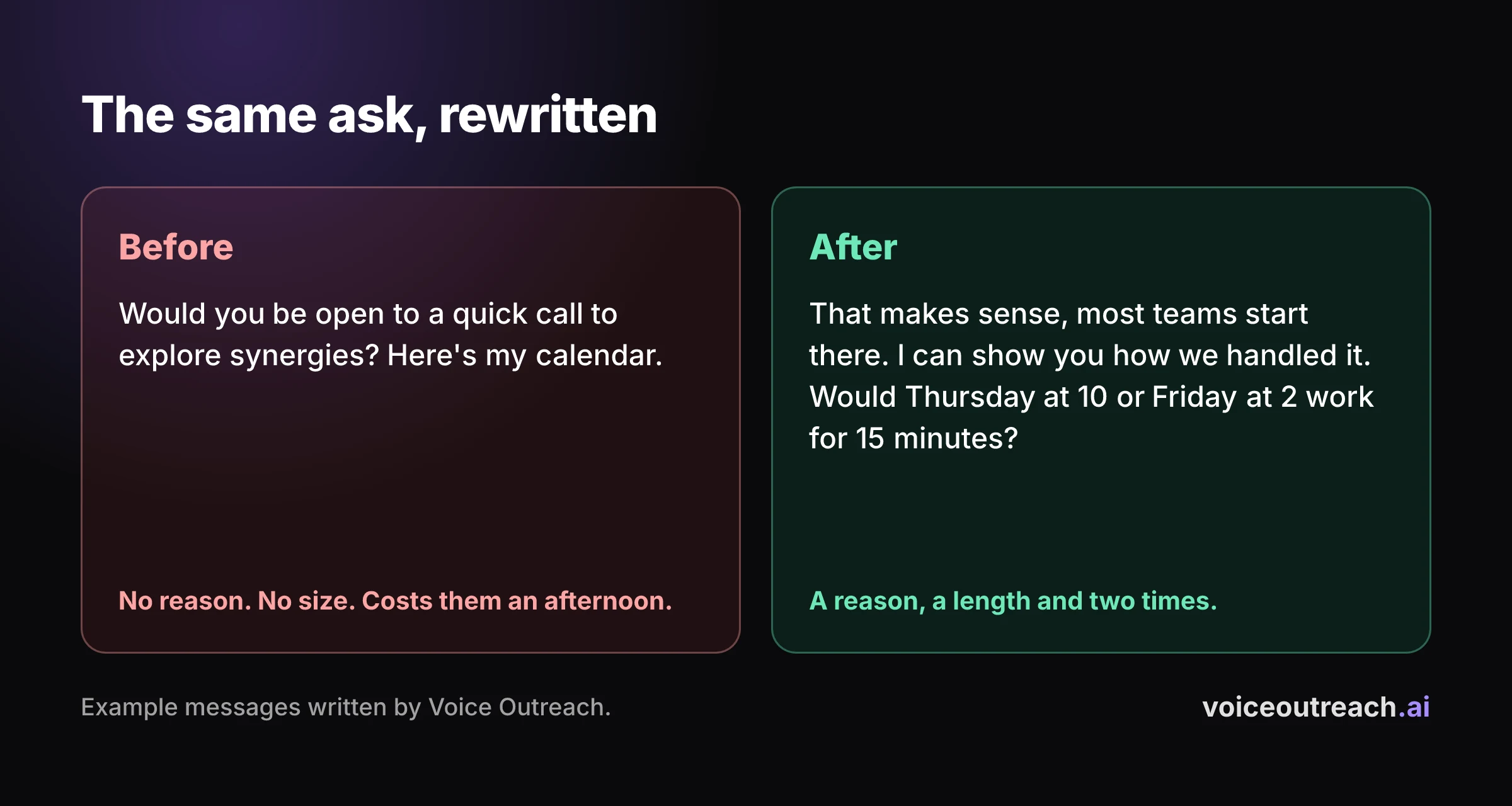
Here is an example I wrote to show the difference. Both are made up.
Before
Would you be open to a quick call to explore synergies? Here's my calendar.
After
That makes sense, most teams start there. I can show you how we handled it. Would Thursday at 10 or Friday at 2 work for 15 minutes?
The second one has a reason, a size and two times. It takes one word to answer.
Where does a voice note fit?
I use two spots: the hello right after they accept, and a short note to suggest the call. Your own voice saying "Thursday at 10 or Friday at 2" sounds like a person, not a booking widget.
I have no evidence that either spot books more meetings than text does. The complete guide to LinkedIn voice notes covers when to send one, and this walkthrough shows how to record one.
Why do booked meetings not happen?
A booked call that does not happen is a separate leak, and it is cheap to fix. This part is opinion, not data.
Send one short confirmation the day before, saying what you will cover. Put the call in their calendar so it does not rely on their memory. Make rescheduling a one line reply, because someone who can move it easily will move it rather than vanish.
If they go quiet after booking, one short message is fine. Then let it go.
How do you find where you are losing meetings?
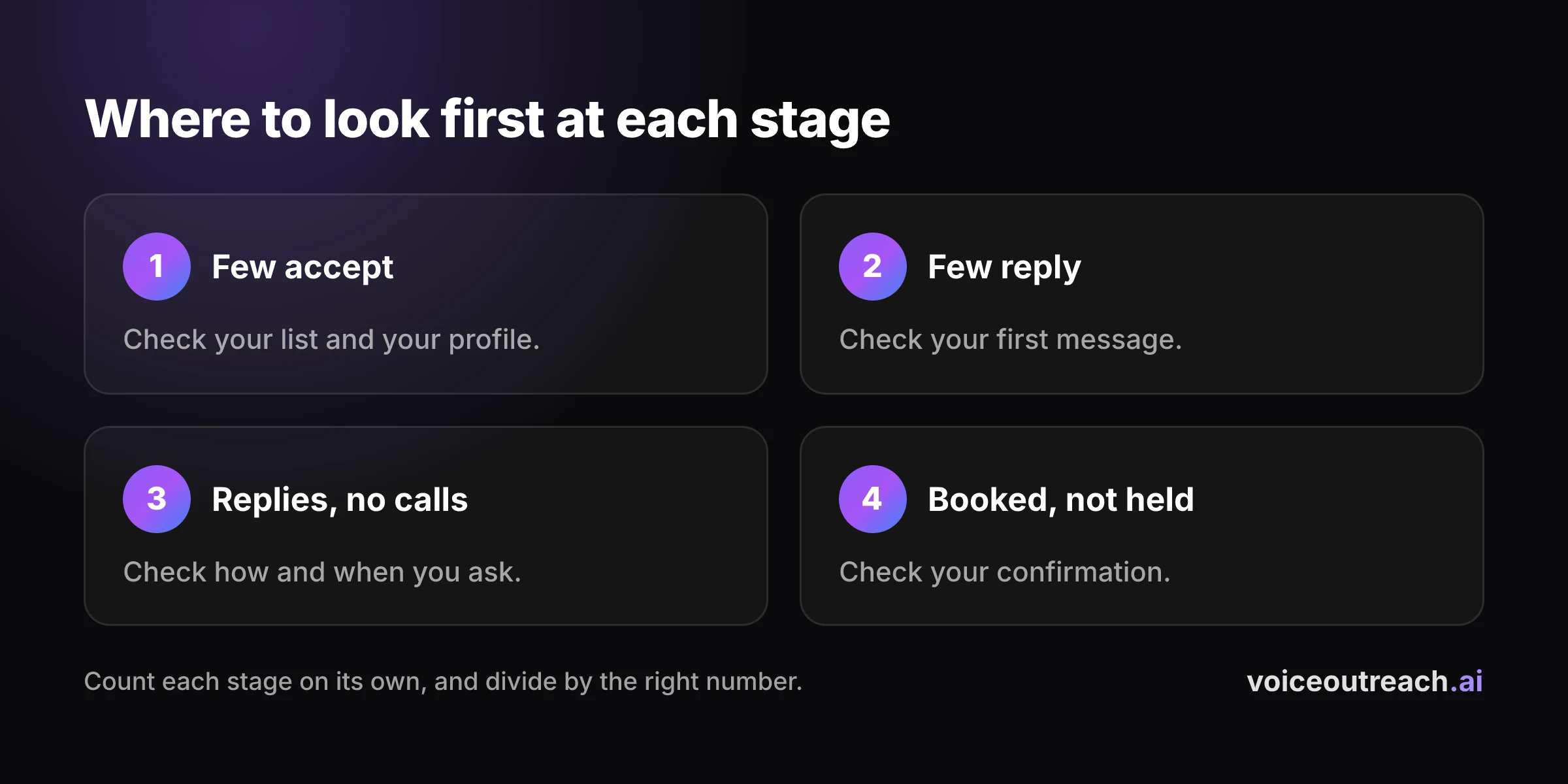
Count each stage on its own, and divide it by the right number. Mixing them up is the commonest way to fool yourself.
| Stage | What to count | Divide by | If it is low, look at |
|---|---|---|---|
| Acceptance | Invites accepted | Invites sent | Your list and your profile |
| Reply | People who replied | People you messaged | The first message |
| Ask | People who agreed to a call | People who replied | How and when you ask |
| Show up | Calls held | Calls booked | Your confirmation |
Group people by the week you invited them, then follow that group. Do not divide this week's replies by this week's invites. Acceptances and replies arrive days later, so the ratio will move for reasons that have nothing to do with your message.
All 16 of our voice note replies came within 7 days, so give a batch a week before you judge it.
A two week test
You do not need a tool for this. A spreadsheet and some discipline will do.
- Change one thing. Pick one list and one message, and leave the rest alone.
- Write down the four counts for each week's group, with the number you divided by.
- Look at the weakest stage and change only that.
- Wait for the numbers to mean something. A few dozen people in a stage is an anecdote, not a rate.
If you use a tool, check that it stops a sequence the moment someone replies. The getting started guide shows how ours is set up, and the pricing page shows the plans.
Frequently asked questions
How many meetings can you book from LinkedIn?
There is no honest universal number, because it depends on your list, your offer and the four rates in the table above. Expandi's public benchmark reports acceptance at 28.5% and replies at 10.4%, and I could not find a meeting rate in it. Be wary of anyone quoting meetings per hundred invites without a method.
What is a good LinkedIn connection acceptance rate?
Roughly one in four. Expandi reports 28.5% across 13.2 million requests from its own users, and in our own outreach it was 23.8%, which is 195 accepted from 819 invites. Both are vendor numbers, so treat them as a range rather than a target.
When should you ask for a meeting on LinkedIn?
After they reply and you have dealt with what they said. Asking in the first message with a calendar link reads as a template, and it costs them more to say yes than a reply does.
Should I send a calendar link or suggest times?
Suggest two times first, because it takes one word to answer. Send the link once they say yes.
How many connection requests can you send a week?
LinkedIn publishes no number. Its help pages say a restriction typically lasts about a week, and that it may restrict accounts with many ignored or pending invitations or suspected automation. Keep volumes at a level a real person could manage.
Do voice notes help you book meetings?
I do not know. In our own outreach 9.0% of voice notes got a reply, which is 16 from 178 and counts any reply, so it is not a meeting rate. I have not seen a published number with a stated method either.
Written by
Hassan Amjad
Founder of Voice Outreach. I send LinkedIn voice notes at scale and write about what actually gets replies.